
Many qualified job seekers are applying, interviewing, and still coming up empty — even as millions of jobs sit unfilled. Why is that happening? This article dives into the strange realities of today’s job market, from ghost job postings and offshored roles to AI replacing entry-level positions and hidden gaps in hiring practices. Using a mix of social media stories, labor statistics, and insider observations, it uncovers the disconnect between what job seekers experience and what the official numbers say.
Social Media Frustration: Graduates & Job Seekers Speak Out
There is a plethora of stories circulating on social media platforms, specifically TikTok and YouTube, shared by frustrated job seekers who cannot find work. Many recent graduates or those recently laid off report filling hundreds of job applications without hearing back from a single employer. Some have a Master’s, PhD, or even a STEM degree, yet they still can’t find work.
The Job Market Is Tougher Than Ever
The job market is increasingly difficult for job seekers to land positions. It can be even worse than it was during the 2008–09 recession. Job seekers are not only applying for positions that match their education and experience but also roles that do not require a degree or experience, such as fast food or grocery store jobs. Some college-educated applicants report being told they are overqualified for a fast food job. When they apply for positions that match their qualifications, they are often rejected in favor of other candidates — and sometimes they don’t even hear back after an interview.
Mass Layoffs, Offshoring, and AI: A Perfect Storm
Some companies have laid off tens of thousands of employees. On top of mass layoffs, job seekers, including both recent graduates and those recently laid off, are struggling to find work. Filling out applications every day without securing interviews or jobs is exhausting. Many have been hunting for six months or more, some for over a year. This struggle is compounded by a combination of companies offshoring jobs, AI advancements, and a weak economy for many job seekers.
Entry-level positions, traditionally a starting point for gaining experience and building skills, are increasingly being replaced or reduced by AI. For example, junior software developer jobs now often require additional years of experience because AI can handle many routine coding tasks. Graduates are left with a lack of entry-level opportunities and jobs demanding 2–5 years of experience. As AI and automation grow more sophisticated each year, questions arise about the future prospects of the job market for many workers.
The Data Doesn’t Always Match Reality
In stark contrast, the U.S. Bureau of Labor Statistics reported 6.2 million private job openings as of January 2026 — but only 5 million private hires in the same month. That leaves 1.2 million unfilled jobs, relatively small compared to the huge post-pandemic gap in March 2022, which saw 11.3 million openings and 6.2 million hires. Looking back at data from 2011 onward (and earlier), hires were typically higher than openings — until 2015, when openings began to surpass hires.
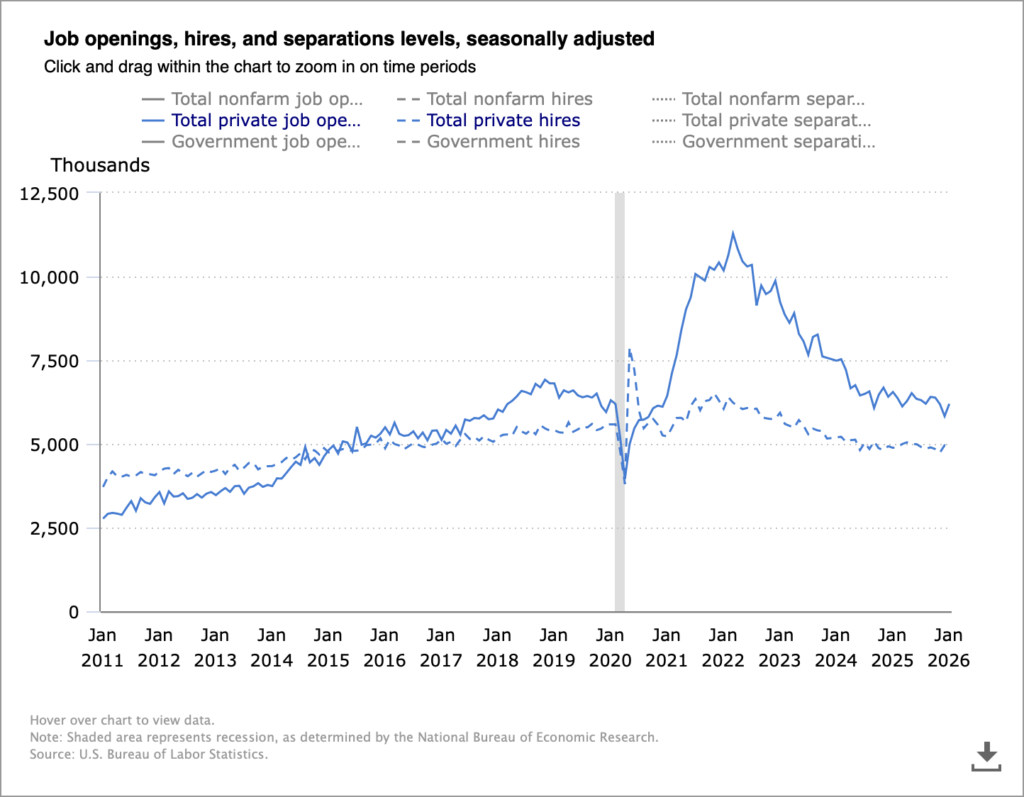
Why were there nearly twice as many job openings as hires in March 2022? Why are there so many openings when many qualified job seekers are struggling to get hired?
Ghost Jobs: What They Are and Why They Exist
This leads to the question of ghost jobs. A ghost job is a posting for a position that may not exist or may not be intended to be filled immediately. Possible reasons for posting ghost jobs include:
- Collecting resumes or building a candidate pipeline
- Seasonal hiring
- Testing the labor market
- Maintaining an appearance of growth to attract investors
- Collecting applicant data or surveys
- Signaling to employees that they may be replaced
Important distinction: A ghost job is not a scam. It is posted by a legitimate company, unlike a fraudulent posting designed to steal personal information. However, not all unfilled openings are ghost jobs. According to Entrepreneur, 27.4% of all U.S. job postings on LinkedIn are likely ghost jobs. Jobs posted for more than 30 days are considered ghost jobs. As cited by The Interview Guys, 45% of HR professionals admitted to regularly posting ghost jobs, while another 48% do so occasionally.
Ghost Jobs vs. Hiring Data: The Illusion of Demand
If ghost jobs contribute to the significant number of unfilled openings, then BLS-JOLTS data may not reflect true hiring demand. This data can create the illusion that companies face staffing shortages, there are too few qualified candidates, or the economy is thriving — when the reality is very different.
Job Hunting Stories from Reddit (r/jobs)
Comment #1:
“I put in 100 applications a day to jobs I am overqualified for!! I still never get an interview or call back! I’ve been staying with my parents because I haven’t been able to land a job that pays enough for me to live on my own!”
Comment #2:
“I received an offer after 3 months of applying with 1,780 applications at around 30–50 per day. It’s still a numbers game.”
Comment #3:
“My company cut hours and laid off 25% of employees, yet they still post jobs. We haven’t looked at applications in months, and job seekers are left wondering why they aren’t getting calls.”
Comment #4:
“Ghost jobs are real and should be illegal.”
Comment #5:
“Corporate pays to keep them. I guess they make more off selling data from resumes than it cost to keep them?”
Comment #6:
“I’m convinced a majority of job listings are fake just to collect and sell info. Two calls in 2 months — one just told me the position was no longer available.”
Comment #7:
“When I managed a warehouse, I didn’t hire a highly qualified applicant because I knew he’d leave for a better role — all training would be wasted.”
My Thoughts
I believe companies post ghost jobs to build a recruitment pipeline, ensuring they have enough candidates ready if layoffs occur or employees give notice. This reduces the time and resources spent recruiting when positions actually need to be filled.
From a job seeker’s perspective, this is incredibly frustrating. You spend hours, days, or even months applying to positions that may never be intended to be filled, often answering unrelated survey questions or providing personal information that could be used for market research rather than hiring.
If a job posting lasts more than 30 days, it may be best not to waste time applying. Similarly, if an application asks questions unrelated to the position, it is likely collecting data rather than looking for a genuine hire.
The irony is striking: large companies are laying off thousands of employees while countless openings remain posted. It paints a misleading picture of a booming job market when, in reality, many qualified candidates struggle to get a foot in the door.
Ultimately, this situation highlights a disconnect between what the data says and what job seekers actually experience. Even as openings appear abundant, the combination of ghost postings, offshoring, and AI-driven shifts in entry-level roles leaves job seekers feeling stuck, undervalued, and often ignored — a reality that doesn’t show up in the numbers.
Sources and References
BLS – Job Openings and Labor Turnover Survey
Entrepreneur – 1 in 4 Job Listings on LinkedIn Are Likely ‘Ghost Jobs,’ According to a New Report. Here Are the Cities Impacted the Most.
The Interview Guys – Ghost Jobs Exposed: The Companies Posting Fake Job Listings (With Proof)
Leave a Reply