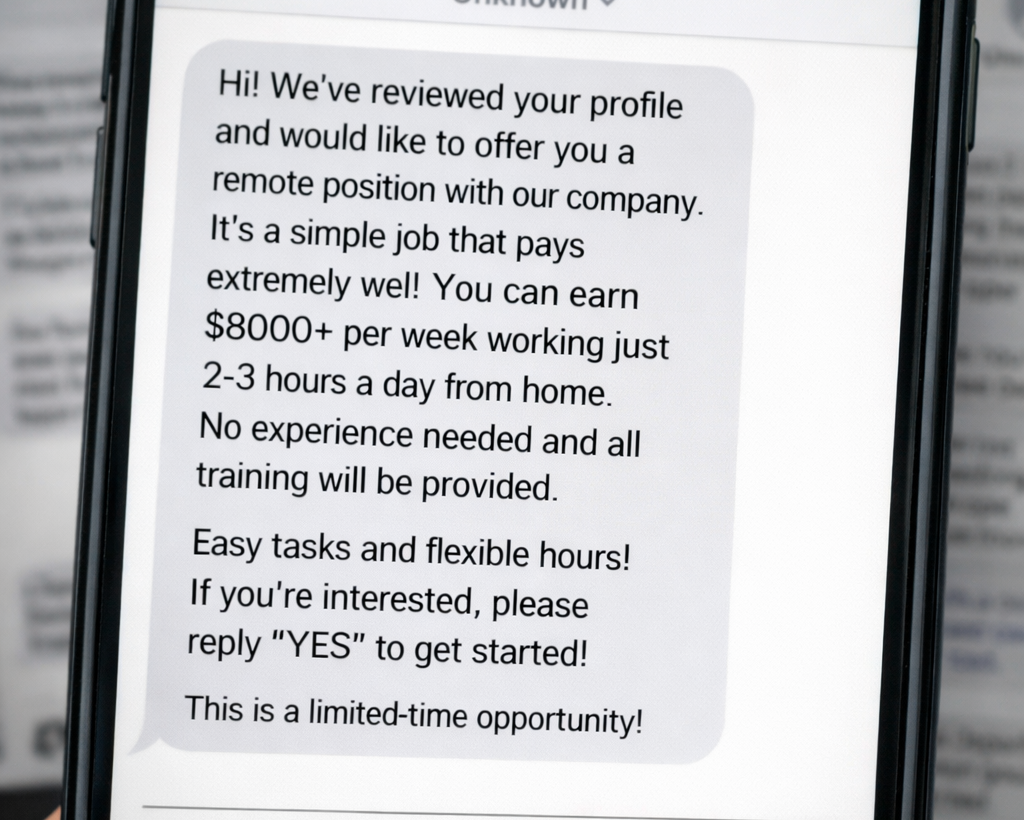
As I sipped my freshly brewed coffee on a crisp fall morning, I received a long text message from an unknown person. The message contained information about a remote job offer. I could see that it was sent not only to me but also to several other recipients.
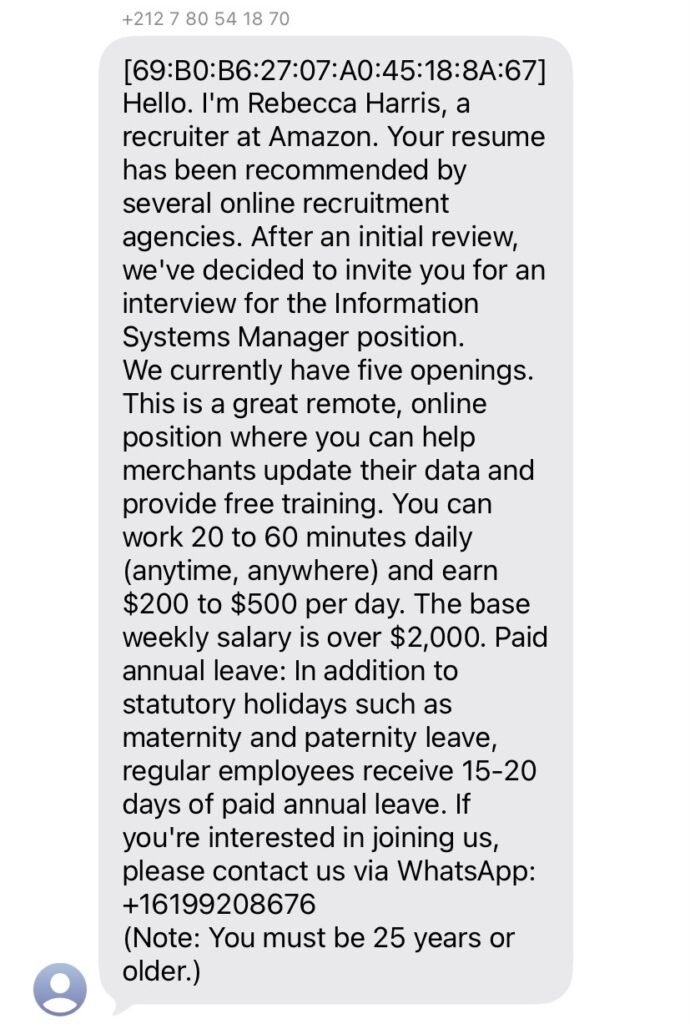
This person introduced herself as Rebecca Harris, a recruiter at Amazon, but did not address me by my name. She said my resume had been recommended to her by several recruitment agencies. She also said that after an initial review, they had decided to invite me for an interview for the Information Systems Manager position. It was a remote position where I could work only 20–60 minutes daily and earn $200–$500 per day. She asked me to contact them via WhatsApp if I was interested.
A note at the end of the message was really strange. It said I must be 25 years or older. I have never seen any legitimate job listing requiring a specific age unless it is 18 years or older. Real companies don’t mention that, even if a job requires 10 years of experience. That age requirement is another red flag.
I clicked on “Delete and Report Junk,” and the scam message disappeared from my iPhone’s list of text messages.
Take a look at a screenshot of the full message that I received from the scammer below.
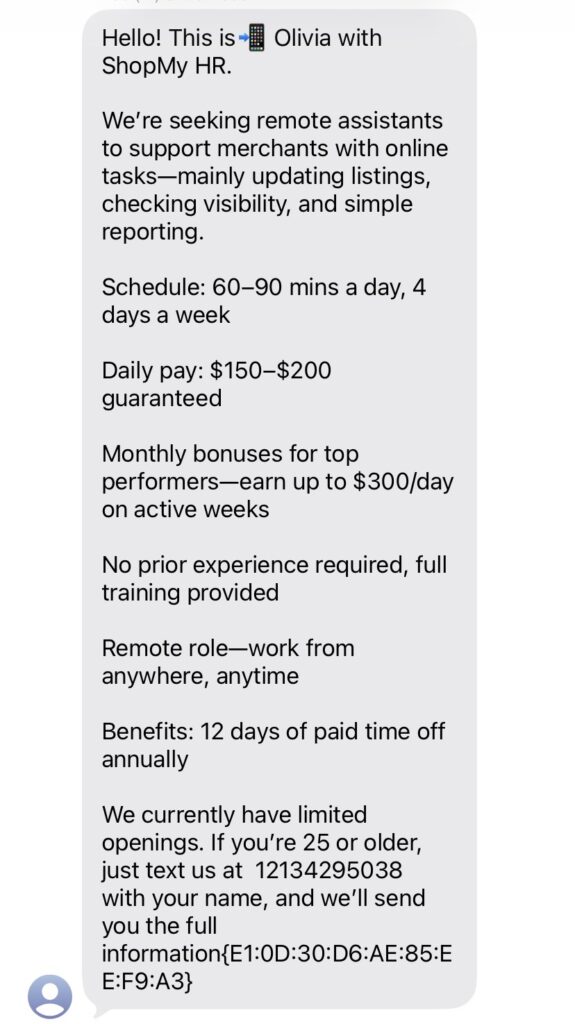
About a week later, I received another similar message from a scammer who called themselves “Olivia with ShopMy HR.” They were seeking remote assistants to support merchants with online tasks. They offered a schedule of 60 to 90 minutes a day for 4 days a week and a daily pay of $150–$200. I could tell that the text was AI-generated. Here is a screenshot of the message.
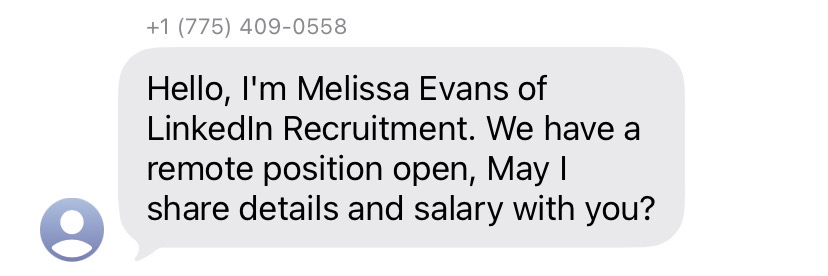
Again, I received another scam message from a person claiming to be Melissa Evans from LinkedIn Recruitment. She said she had a remote position available and asked if she could share details and salary. Of course, I deleted the message and reported it as junk immediately.
Unfortunately, some job seekers fall for these job scams, which can cost them thousands of dollars. Scam jobs are on the rise with the help of modern technology such as texting, social media, and AI. Many scammers are taking advantage of the slow job market. This makes it easier for them to target vulnerable and desperate job seekers, especially older job hunters.
In this article, we will delve into the types of job scams, how they work, how common they are, and what tactics scammers use. We will also look at job seekers’ experiences with job scams on discussion forums and social media. Then I will share my final thoughts.
Statistics on Job Scams
According to PasswordManager.com’s survey between 2020 and 2021, 38% of job seekers reported encountering scam job listings online, and 32% were tricked into applying for or interviewing for a fake job. Among them, 15% had personal data stolen and 9% had money stolen by scammers.
Cited by FlexJobs, 27% of job seekers reported being victims of a job scam. 12% said they were scammed more than once. 45% said recognizing and avoiding job scams is one of the biggest job search challenges.
Apparently, some job seekers have difficulty distinguishing between real jobs and fake ones. Scammers are becoming more sophisticated than ever with the help of AI. They use AI to generate realistic job descriptions for fake jobs that they use to scam unsuspecting victims.
7 Common Types of Job Scams and How They Work
1. Fake Check / Equipment Purchase Scam
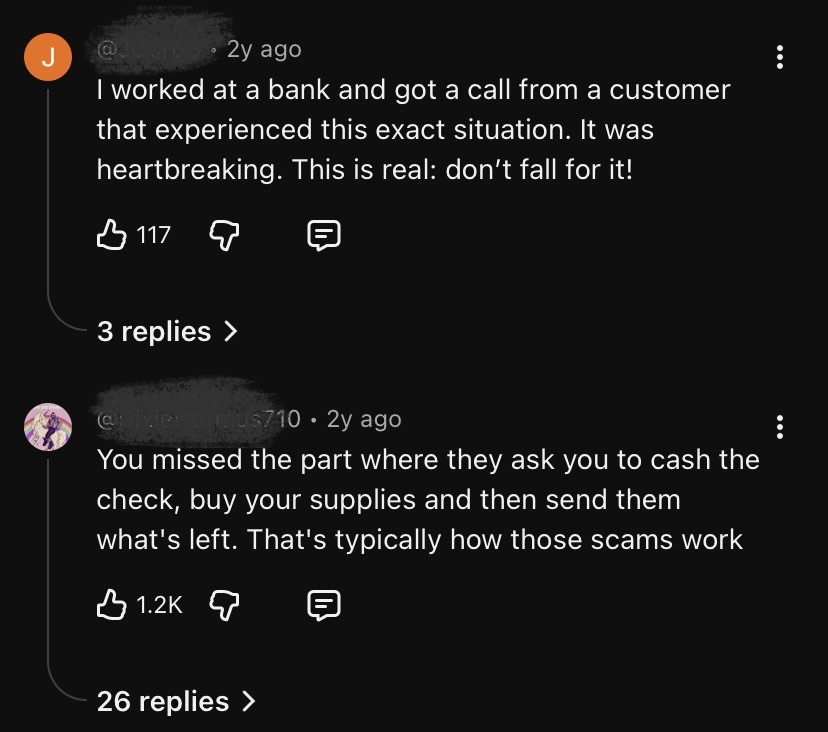
An “employer” sends you a check and asks you to buy work equipment from their preferred vendor. When you deposit the check, it is initially accepted by your bank, making it seem legitimate. The money may appear available in your account within 1–2 days. However, the check has not actually cleared yet. During that time, they instruct you to use your own money to buy equipment from a fake vendor. Days later, the bank discovers the check is fake and reverses the deposit. Now, you lose your real money.
2. Upfront Payment / Pay-to-Work Scam
After you get hired, you are asked to pay for training, certification, background checks, starter kits, and possibly more. Once they receive the payment, they disappear. No legitimate employer would ask you to pay for training, background checks, or anything else.
3. Phishing / Personal Information Theft
In the early part of the hiring process, a fake employer asks for your SSN, birth date, home address, ID documents, and bank details. Sometimes, they send fake forms or links to phishing websites that look real. Once you give them your personal information, they can use it to open credit cards, take out loans, access bank accounts, create fake identities, or sell it to other scammers.
4. Reshipping / Package Mule Scam
You apply for a job like “Package Handler,” “Shipping Coordinator,” or “Quality Control Inspector.” The job is usually remote and promises easy money. You are told you will receive packages and forward them, which sounds like legitimate warehouse or fulfillment work from home. Once you receive shipments, the “employer” tells you to repackage them, print shipping labels they provide, and send them to new addresses. What you don’t know is that these items are often purchased using stolen credit cards. You are acting as a middleman to hide the scammer’s identity. Eventually, the scam can be traced back to you after victims report fraud.
5. Overpayment Scam
After being “hired,” an employer sends you a check for more than expected. They say they accidentally sent you $3,000 instead of $1,500 and ask you to return the extra money. They instruct you to send it via Zelle, Cash App, wire transfer, or gift cards. Eventually, the original check bounces, and the money you sent back is your own and gone.
6. Pyramid Schemes
Pyramid schemes are often presented as job opportunities or business ventures, but they operate very differently from legitimate employment. Instead of earning money through actual work, participants are typically required to pay upfront fees and make income mainly by recruiting others into the system. While they may involve real products or services, the structure relies on a constant flow of new participants, which means most people end up losing money.
7. Task Scam or “Click Work” Scam
You are offered an easy remote job that promises high pay for simple tasks. Job titles sound appealing, such as “App optimizer,” “Product reviewer,” or “Data clicker.” For example, you might be told you can earn $200 a day just by clicking and reviewing products. You complete tasks on a platform they provide. At first, you may receive small payments, which makes the job seem real. Later, they tell you to deposit money to unlock higher earnings, access premium tasks, or maintain a minimum balance. The platform may show growing earnings, but those numbers are not real. When you try to withdraw money, you are either blocked or asked to pay additional fees. Eventually, the platform disappears, and your money is gone.
The End Goals of Job Scams
The primary objective in many scams is to steal money. As mentioned earlier, scammers use fake checks, overpayments, deposits for higher earnings, and upfront fees to get your money. They may also gain access to your financial accounts by asking for your bank details or setting up fake direct deposit systems.
Some scams are not about immediate money but about collecting your personal data. They ask you to fill out personal details such as your full name, SSN, home address, and ID documents. They use this information to commit financial fraud or sell your data on the dark web.
Another goal is to use you as a tool for exploitation. In some scams, you become part of the operation without realizing it. Examples include reshipping stolen goods, transferring stolen money, or processing fraudulent transactions. These roles help scammers stay anonymous and avoid being traced.
Job Seekers’ Stories on Reddit Forum and Social Media
We can look at posts from Reddit users who have had personal experiences with job scams. If you want to see more of this type of content, you can check out Reddit/job scams. Many job seekers share their experiences, and others post warnings about ongoing scams on that forum. It is incredibly useful and informative.
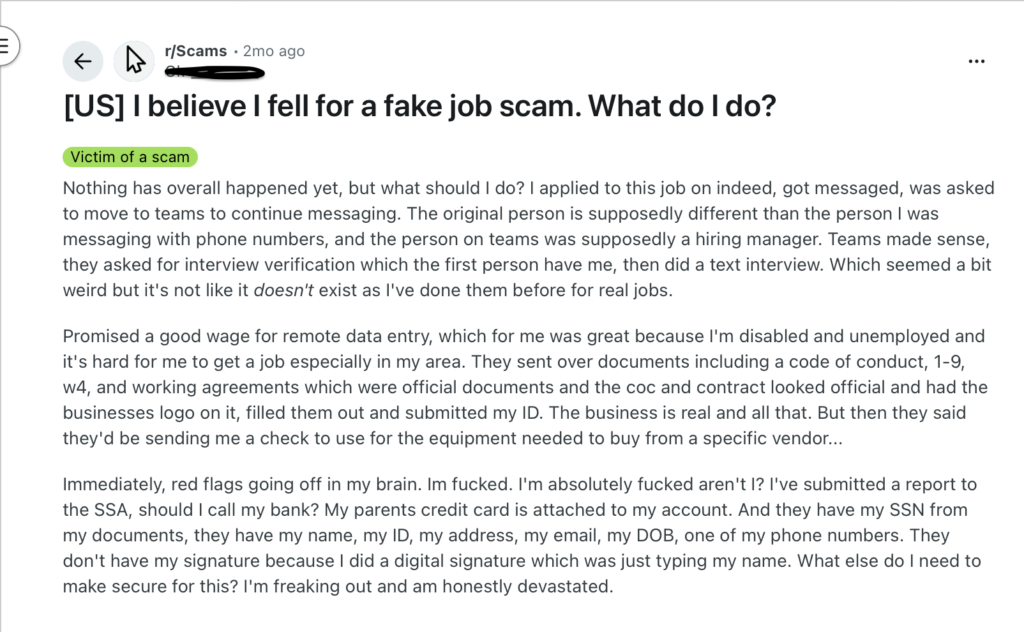
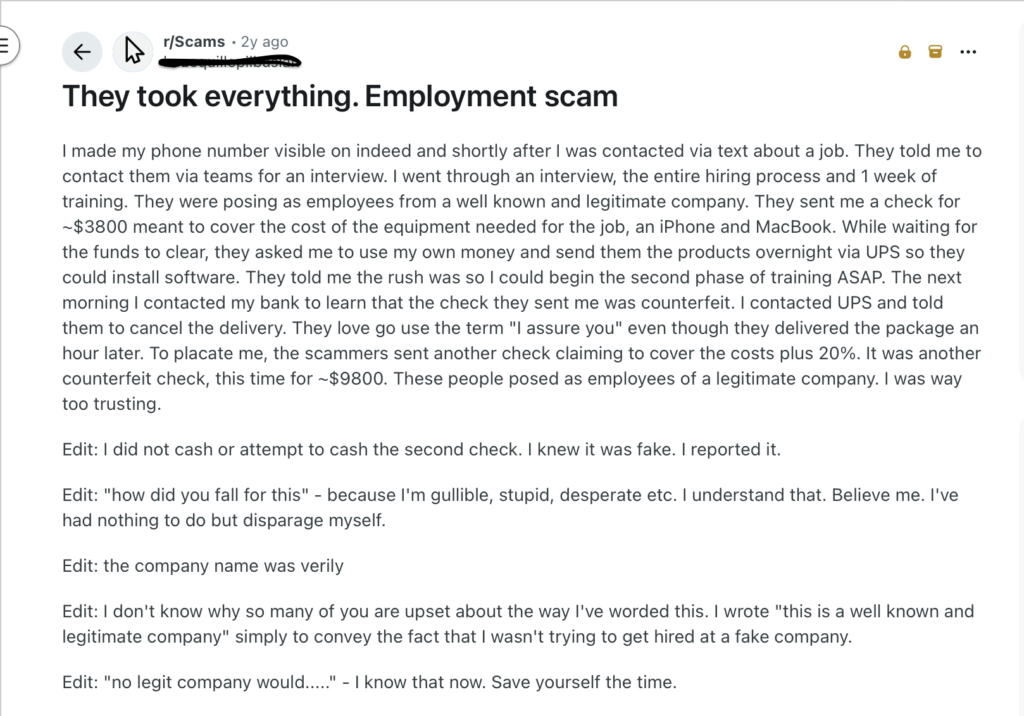
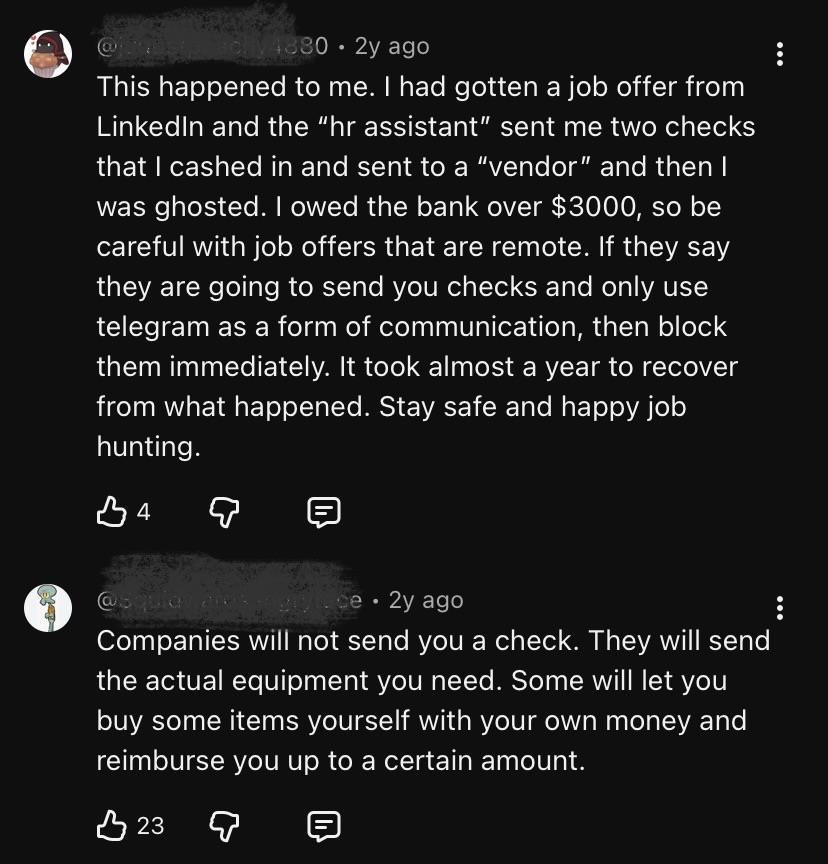
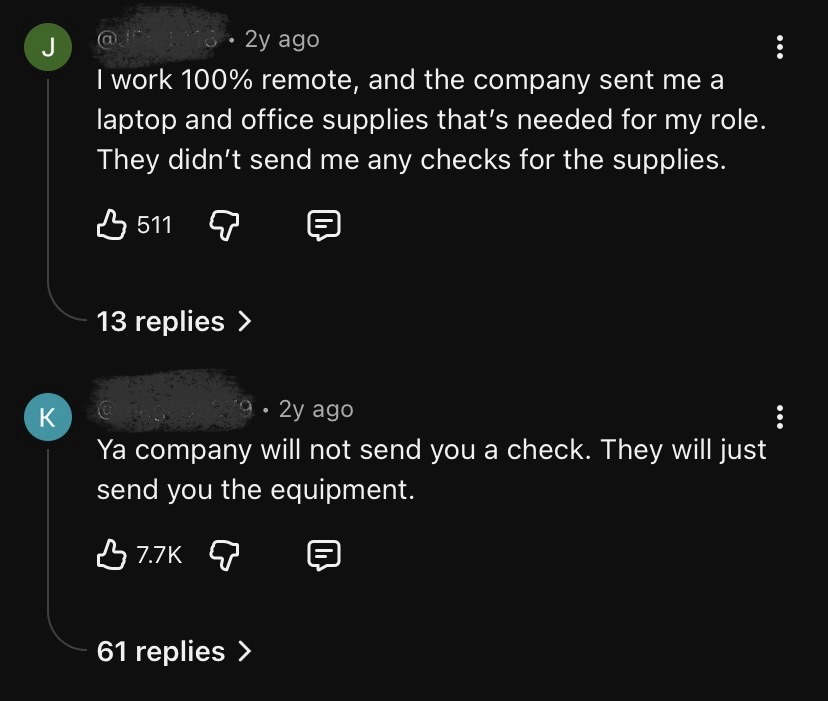
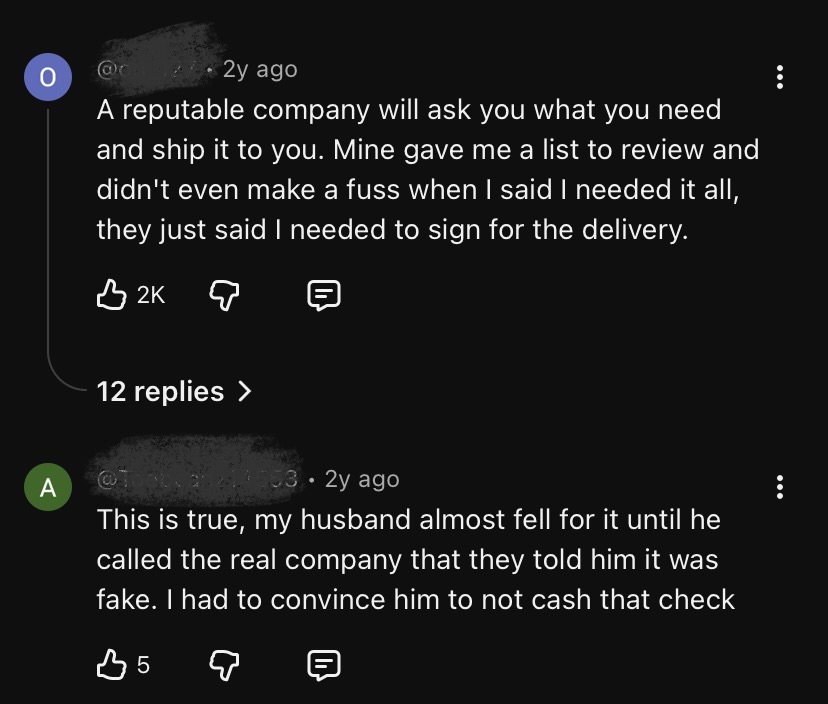
We also have comments from a YouTube video about fake employers sending checks to job seekers to buy equipment. Some people share their personal experiences, others talk about scams that happened to their friends or family, and many provide helpful advice.
My Final Thoughts
We have looked at a list of common job scams along with Reddit and YouTube comments. We saw that some people fell for these scams while others could spot them immediately. Based on that, it seems that those who fell for scams did not do enough research on the employer. They went along with the process until they realized it was a scam. When you are desperate for a job, it is easy to ignore red flags.
As a job seeker, it is always best practice to walk away from a recruiter who wants to interview you only through text. Any real company would want to interview you in person or through video if the role is remote. If your intuition tells you something is off, listen to it.
You should never give out your personal information to an employer over text or email early in the process. Only do that after receiving an offer, meeting them in person or through video, and verifying that the company is legitimate. You must research the company first to understand what it does and whether it actually exists. Always research a company before moving forward.
If the opportunity seems legitimate, check the email address of the recruiter to see if it matches the company’s domain. Also check the company’s website to confirm that the job posting exists and contact them directly to verify. If the company does not have a website, it is most likely fake.
Fake check and equipment scams seem to be extremely common. Honestly, I am not sure how someone could easily fall for this. If an employer sends you a check to buy equipment from their vendor, why wouldn’t they buy it themselves? Think about that. If you ever encounter something like this, do not deposit the check. Walk away. No legitimate company would do that. They would send the equipment directly to you.
You should never pay any upfront fees for background checks or training. A real company would cover those costs. You should never deposit money to earn higher payouts on a platform. You work to make money, not to pay for it.
I know this may seem like a lot, but it can save you time, money, and stress. The job market is becoming more difficult and competitive. No job is simply handed to you. A job is like a fish, you have to go catch it. So the next time you receive a text or email from a recruiter offering you a job, do yourself a favor and think twice before responding.
Before you go, it’s worth noting that job scams are not the only issue affecting job seekers today. Another growing problem is ghost jobs, which are job postings that appear legitimate but are not actually hiring or intended to be filled. While they are not scams in the traditional sense, they can still waste a significant amount of time during the job search. If you want to learn more about this topic, you can check out my article on ghost jobs.
Sources and Reference:
Leave a Reply